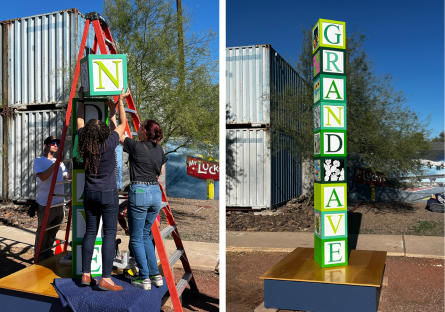
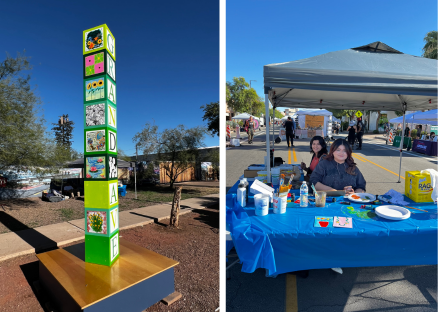
When passersby encounter the 11.5-foot tower of colorful letter blocks spelling "GRAND AVE" on Grand Avenue, they're looking at more than a whimsical sculpture. They're witnessing the culmination of a collaborative educational experiment that gave Phoenix College art students hands-on experience in the competitive world of public art.
The Block Party sculpture, designed and fabricated by students from Phoenix College's sculpture and painting programs, stands as both an eye-catching installation and a teaching tool for the professional realities that working artists face. Created for the Grand Avenue Arts Festival, the project brought together beginning sculpture students, painting students, and multiple community partners. The project provided students with insights into a range of topics, including public art proposal development, hands-on and digital fabrication techniques, and installation logistics. Through active participation, students gained practical experience in design planning, teamwork, and problem-solving, which are essential skills for today’s working artists.
From Concept to Collaboration
The project emerged from conversations between sculpture instructor Zach Valent, painting instructor and Visual Art Program Director Jay Hardin, and Greg Hawk, owner of Hawk Salvage and a retired firefighter who organizes the Grand Avenue Arts Festival. Like many community members who are non-degree seeking art students, Hawk has taken classes with Valent and Hardin and previously collaborated with Hardin on a ground mural for Grand Avenue, but the team wanted something more interdisciplinary for their next partnership.
"We were trying to figure out something that the sculpture students and the painting students could collaborate on together," Valent explained. During an on-site meeting at Grand Avenue, the idea for the stacking blocks clicked.
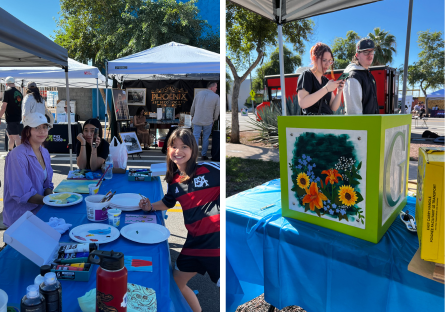
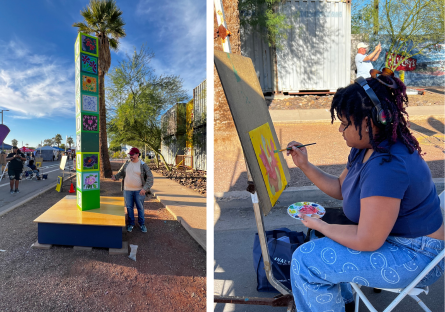
While the initial concept came from the faculty and festival organizers, the students made the project their own. They chose the floral paintings for the block panels, selected the color palette, named it Block Party, and completed the vast majority of the fabrication work. Ten students from the sculpture program handled construction while twenty artists from the painting program created the twelve-inch-square floral panels that adorn the blocks' sides.
Fabrication team – Sculpture Students
Colleen Leroy | Jesus Cole | Karina Saldana | Penelope Coles | Jennie Luciu | Reaux Maroun | Anna Rivers | Terri Waugh | Jessica Wilson | Wendy Whatley
Floral Paintings – Painting and Sculpture students:
Abigail Arevalo | Ernesto Garibay | Alexus Santa Cruz | Mellissa Leor | Tabitha Ramirez | Aajaylah Tucker | Dolly Garcia | Jeyla Rodelo | Maelin Davis | Mason Whatley | Jennie Luciu | Jesus Cole | Penelope Coles | Karinna Saldana | Jasmine Monroe | Colleen Leroy | Terri Wraugh | Anna Rivers | Kevin Bresee | Jade Deming
Building Professional Skills Block by Block
For Valent, who runs his own studio focused on public art fabrication and installation, the project represented an opportunity to introduce students to the business side of art much earlier than he had experienced it himself. "I talk about commission work, what goes into developing a budget, and the cost of making these things. Also, how to handle red tape and the logistics behind making something like this, including the timeline and the amount of labor," he said.
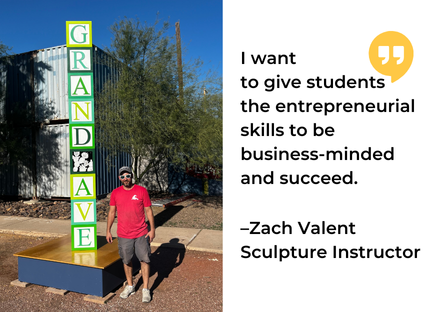
The entrepreneurial aspects of art-making, Valent believes, have been undervalued in traditional curricula. "I want to give art students the entrepreneurial skills to be business-minded and succeed. Those are almost more important than—I wouldn't say that it's more important than teaching them tools and craft—but I think that it's a very underestimated and undervalued part of the curriculum."
Arizona's robust public art scene makes these skills particularly relevant. The state's municipalities regularly issue calls for temporary and permanent installations, creating opportunities for emerging artists willing to navigate the application process. "Arizona is really leading in public art. I apply to almost everything that comes out of the Valley. It is very, very competitive," Valent noted. He emphasized that students need early exposure to this process, including learning to handle rejection amidst success. "You have to submit a bio, resume, portfolio, image list, cover letter, all that stuff, and then turn around and be prepared for a rejection letter. That's hard." But the more students experience that reality while in school, the better they'll be able to deal with it when making a living as an artist.
Technical Ambition Meets Community Resources
The project's technical complexity pushed students beyond the basics of woodworking. Each of the nine hollow blocks measures fifteen inches on all sides, constructed from three-quarter-inch plywood with mitered joints and internal reinforcement . The blocks mount on a central steel post housed in a weighted base that tips the scales at approximately 1,100 pounds—a necessity for a freestanding sculpture of this height.
What elevated the project from painted letters to professional-quality installation was the students' ambition to have the letters routed into the wood surface, mimicking traditional toy blocks. "Several of them piped up: Are we actually going to emboss the surface of these things like ABC blocks, or is it just going to be painted on the surface?" Valent recalled. A student who had previously worked with Phoenix Forge, a community makerspace in downtown Phoenix run by Gateway Community College, suggested that they use the facility's CNC milling equipment. Valent inquired about access, with just four weeks until the installation deadline. The Forge staff, particularly Wood Shop Manager Jordan Chaffin and Associate Director Ben Bednarz, proved enthusiastic partners.
Nine students completed the wood shop orientation at Phoenix Forge, and the entire group showed up outside of regular class time to assist with the CNC work. "They're invested because it's going to be a public installation," Valent said. The partnership also gave students ongoing access to the Forge's facilities for future projects.
A Monument to Student Investment
The sculpture's construction required coordinating multiple work sessions, sourcing materials within a $1,500 budget, and applying weatherproofing treatments to ensure the temporary installation could withstand outdoor conditions for several months. Students tackled everything from routing the letters on the blocks to applying dry-lock primer and multiple coats of paint. What struck Valent most was his students' commitment. The class, after all, was a beginning sculpture class, not an advanced course. "They did a phenomenal job together," he said. "It was definitely one of the easiest group projects I've ever done, so smooth and so fluid the entire time."
Beyond the Festival
As a temporary installation, Block Party faces an uncertain future. Municipal regulations make permanent placement complicated, requiring a subsurface concrete base rather than the weighted system currently supporting it. After its run on Grand Avenue, the sculpture will likely return to Phoenix College, where the blocks can be rearranged to spell "GARDEN" for display in the campus Pollinator Garden adjacent to the art builiding.
Valent hopes to work with Hawk to navigate the requirements for a more permanent Grand Avenue installation, viewing the sculpture as dual-purpose: both art and an advertisement for what Phoenix College's art programs can accomplish. But he's also realistic about temporary public art. For the participating students, Block Party provided portfolio material, professional experience, and proof that beginning artists can undertake ambitious public projects. "You have the photos, you have the line on your resume, you have the experience to talk about it as you move forward and apply to opportunities and jobs," he told his students.
As Valent balances his teaching with his own public art practice, projects like Block Party represent his vision for art education: practical, professional, and collaborative from day one. "I'm dually passionate about teaching and being an artist," he reflected. "Definitely nothing to complain about." The nine blocks stand as a testament to what happens when educational institutions embrace real-world collaboration, when students are trusted with professional-level challenges, and when community partnerships open doors to resources that expand what's possible in the classroom.
To hear more about “Block Party” and its installation at the Grand Avenue Festival check out this YouTube short filmed by Lucas Anderson from Phoenix Forge.
Explore your artistry with a class. Search Spring 2026 ART class offering. Or consider a degree program in Visual Arts.