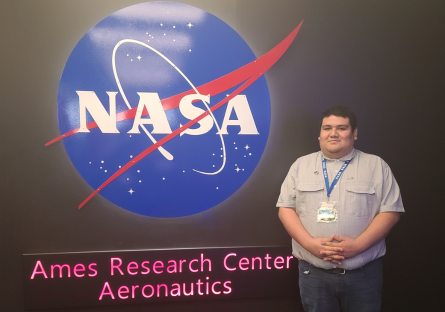
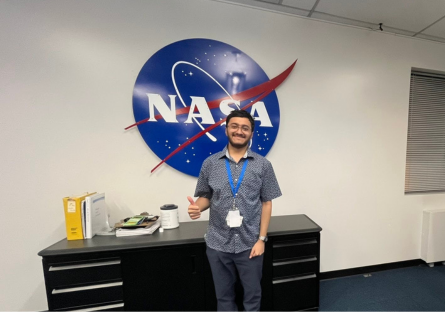
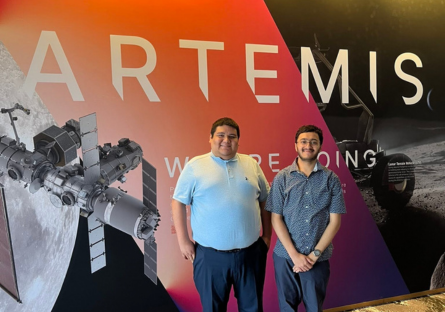
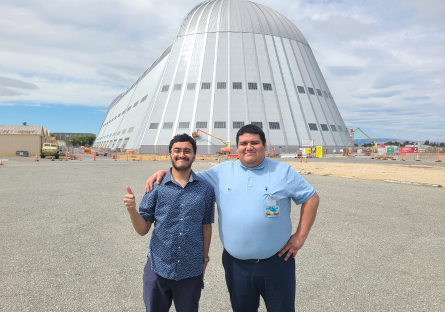
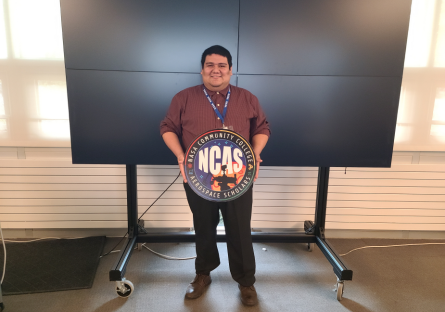
At the end of July, Phoenix College (PC) students Jesus Zermeno and Varun Murale spent an extraordinary week at NASA's Ames Research Center in California, where they participated in NASA Community College Aerospace Scholars (NCAS) Mission 3—the culminating experience of a highly competitive three-part program. Jesus and Varun's journey from community college classrooms to the halls of NASA represents personal triumph and the power of educational programs designed to open doors for underrepresented students in STEM fields.
The Path to NASA
Both students discovered the NCAS opportunity through PC's MESA (Mathematics, Engineering, Science Achievement) program and their MESA mentor, Dr. Frank Marfai, a former NASA Jet Propulsion Laboratory (JPL) engineer, now PC math professor.
Jesus spent seven and a half years working as a sanitation worker following high school, when he finally said, "This can't be it—I love math. I love science. I love things that fly. I want to be an engineer. I want to go back to school."
Varun's path was equally compelling. Born in the US but educated in India for twelve years, he returned to Phoenix with dreams of engineering but little knowledge of the American educational system. Starting in the lowest-level math class at PC, he worked his way up through sheer determination, eventually taking 12 credit hours in a single summer.
Initial doubts about their qualifications for pursuing the NCAS opportunity proved unfounded. Jesus recalled Dr. Marfai's advice: "You will miss all the shots that you don't take."
A Three-Mission Journey
NCAS operates as a progressive three-mission program, each building on the previous experience. Mission 1: Discover required students to create infographics on aerospace-related topics. Mission 2: Explore randomly assigned students to teams with community college peers from across the country and tasked with proposing lunar missions. Jesus worked as a software specialist, developing programming flowcharts for an autonomous rover to explore dark lunar craters. Varun was a computer engineer and project manager who dealt with budget constraints and technical specifications.
"We had to do research into battery technology, hardened radiation-resistant processors," Varun explained, describing the technical depth required.
Mission 3: Innovate brought the students face-to-face with NASA's cutting-edge research in an on-site experience at NASA Ames Research Center. The competition was fierce for these missions. Of 1,000 applicants for Mission 2, only 120 students were selected. For Mission 3, only 80 advanced.
Inside Ames
Arriving in California with all expenses paid by NASA (plus a stipend), the students were assigned a cohort and immediately immersed in the Advanced Air Mobility (AAM) program, focusing on electric vertical takeoff and landing aircraft.
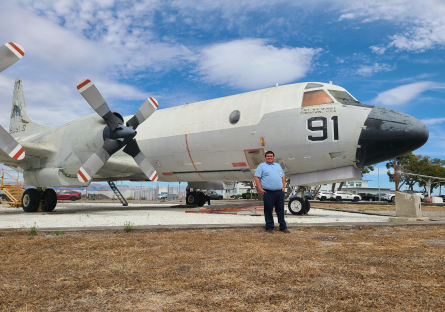
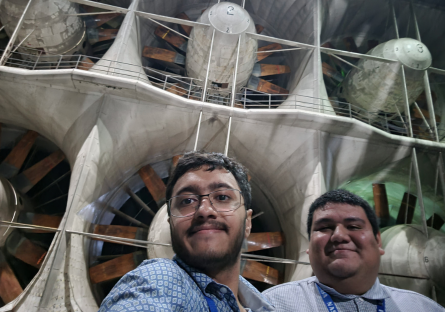
The week's highlight was job shadowing with actual NASA personnel. Jesus was paired with a risk mitigation specialist who worked with wind tunnel testing, seeing firsthand how NASA creates and tests scale models of aircraft before progressing to full-size prototypes.
"They have a ton of different-sized wind tunnels," Jesus noted. "The world's largest wind tunnel fits a full 747 jet. It is huge."
Varun shadowed a project manager who provided insights into NASA's collaborative approach with private industry. "NASA helps develop the research technology first, and then they pass it on to third parties," Varun said, emphasizing NASA's role as a research catalyst rather than a direct competitor.
Tackling Real-World Challenges
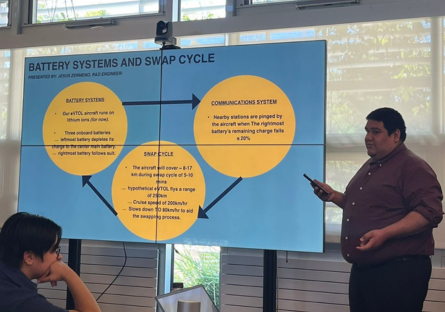
The students' final projects addressed practical challenges in advanced air mobility. Jesus's Team Blue focused on cargo transport, developing an innovative concept for mid-air battery swapping stations. Jesus shared the question raised in their ideation phase–What if the electrical aircraft can stay in the air, but gets the battery swapped out in mid-air by stations?–inspired by military aerial refueling. The concept addressed one of the fundamental limitations of electric aircraft: limited range due to heavy battery requirements.
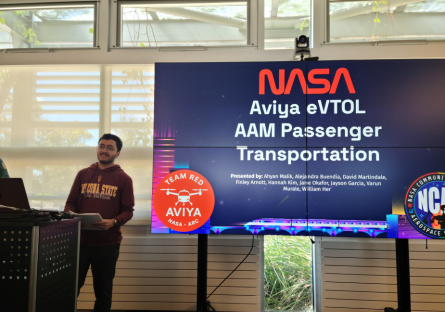
Varun's Team Red tackled passenger transport, designing an aircraft for California's Bay Area based on existing research from local universities. Their challenges included autonomous flight capabilities, air traffic control integration, and noise pollution concerns.
"You can't just factor in traditional air traffic control because you're dealing with tens or hundreds of thousands of aircraft at once," Varun noted, highlighting the complexity of integrating these new vehicles into existing airspace.
Both projects required extensive research into battery technology, composite materials, sensor systems, and regulatory challenges. The students also had to consider technical feasibility and sustainability goals, including economic, social, and environmental tradeoffs.
The Power of Community and Mentorship
Throughout their journey, both students emphasized the crucial role of Phoenix College's MESA program and their various mentors. Sam Ortiz, a MESA advisor, helped Varun navigate degree requirements and transfer planning. Phi Theta Kappa (PTK) Honor Society advisor Amy MacPherson connected them to additional opportunities. Dr. Marfai was a mainstay of continued encouragement. “Their journeys show what is possible when we ignore that inner voice that tries to talk us out of trying things that seem out of our reach,” he said. “When we believe in our own potential and then take positive steps to act on it, there are no limits in what we can accomplish. Jesus and Varun’s hard work and efforts earned both of them the opportunity to visit and showcase their projects to NASA professionals at one of NASA’s centers. How cool is that?"
"The MESA program literally changed our lives," Jesus emphasized. "Because of the MESA program, I was also awarded a St. Vincent de Paul First Gen scholarship, which will cover my tuition for the next four years."
The friendships formed during the NASA experience proved equally valuable. "One of the things I loved most about the whole experience was meeting other students who are just like us," Jesus reflected. "They have the same ambitions, want to work in STEM fields, and love knowledge."
Looking Forward
With direct connections to NASA leadership, including contact with high-ranking officials who expressed interest in their future internship applications, Jesus and Varun are now focused on completing their degrees. Jesus will stay at Phoenix College for another year before transferring to Arizona State University (ASU) to study electrical engineering. Varun completed his associate's degree in May and transferred to ASU to start his computer systems engineering program.
The NCAS experience represents more than just a week at NASA—it demonstrates how community colleges can serve as launching pads for extraordinary opportunities. Through dedicated programs like MESA, mentors who believe in student potential, and students willing to take risks on themselves, the path from community college to NASA becomes not just possible, but transformative.
Jesus and Varun carry with them not only the technical knowledge and professional connections, but also the confidence that comes from proving—to themselves and others—that any dream is within reach with the right support and determination.
Their story is a powerful reminder that the most essential qualification for reaching extraordinary heights is simply the willingness to apply and give your best effort.
–––––––
Interested in reaching new heights in your own STEM goals? Consider applying to the MESA program for support, mentorship, and extraordinary opportunities to put you on a path to fill the future workforce needed in these fields.
Already working in a STEM field? Be a MESA mentor and support our aspiring STEM students in reaching their potential. Contact Caitlin Gaspar at [email protected] or 602-285-7676.
Acknowledgements: As an editorial experiment with generative AI, Claude was used to generate an initial draft of this story from a 50-minute, human-led interview with Jesus and Varun on August 11, 2025.