


After high school, Phoenix College student Jesus Zermeno spent seven and a half years working as a sanitation worker, when he finally said, "I love math. I love science. I love things that fly. I want to be an engineer. I want to go back to school.” The mentorship he received at Phoenix College gave him the confidence to pursue opportunities he didn’t think he was smart enough to pursue. Dr. Frank Marfai, a Math professor and Mathematics, Engineering, Science, Achievement (MESA) program advisor, encouraged Jesus to apply to the NASA Community College Aerospace Scholars (NCAS) program. Jesus advanced through Mission 1, then Mission 2, working as a software specialist, developing programming flowcharts for an autonomous rover to explore dark lunar craters. Finally, he advanced to the highly selective Mission 3, which brought him face-to-face with NASA's cutting-edge research in an on-site experience at NASA Ames Research Center. Zermeno said PC’s staff and faculty “provide so many opportunities, so many resources, they literally change our lives.”
Operations Economic Impact
The education, training and skills students gain at Phoenix College to increase their employability and have fulfilling and prosperous careers translates into real economic value for Arizona, according to a study conducted by Lightcast using Maricopa County Community College District (MCCCD) FY 2023-24 academic and financial reports, U.S. Bureau of Labor Statistics U.S. Census Bureau industry and employment data, and a variety of studies and surveys relating education to behavior. In fiscal year (FY) 2023-24, Phoenix College employed 1,183 full-time and part-time staff, 94% of whom lived in Maricopa County, for a total payroll of $60.2 million, much of which was spent in the county on groceries, mortgage and rent payments, dining out, and other household expenses. The college also spent $31.8 million on facilities, supplies, and professional services.
Student and Alumni Economic Impact
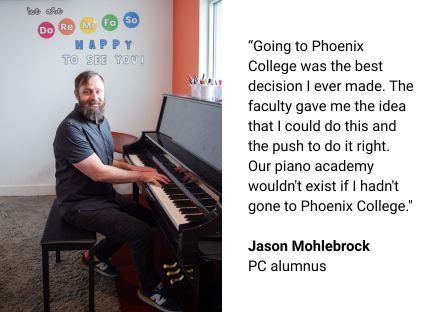
Students, while attending the college, generated $97.6 million in added income for the county from money spent on groceries, accommodation, transportation, and other household expenses. Yet, the greatest impact comes from Phoenix College alumni, who as a result from their education receive higher earnings and increase the productivity of the businesses that employ them. Or they open their own businesses in Maricopa County. PC alumnus Jason Mohlenbrock, co-owner of Blue in Green Youth Piano Academy with his wife Shawna Craig, said, “Going to Phoenix College was the best decision I ever made. The faculty gave me the idea that I could do this and the push to do it right. Our piano academy wouldn't exist if I hadn't gone to Phoenix College." In FY 2023-24, PC alumni generated $712.4 million in added income for the county’s economy.
Total Economic Impact
PC’s total impact of $897.5 million supported 10,953 regional jobs, using the jobs-to-sales ratio specific to each industry in the county. This means that one out of every 295 jobs in Maricopa County is supported by the activities of Phoenix College. Job industry sectors include Education, Health Care & Social Assistance, Professional & Technical Services, Arts, Entertainment & Recreation, Retail, and Hospitality.
Student Return on Investment
As a first-generation immigrant student, Aryanaz Besharatlou has been enamored by technology since childhood, drawn to its complexities and possibilities. Her lifelong fascination has steered her towards pursuing a Bachelor’s degree in Information Technology at Phoenix College. She has emerged as a leader on campus, serving as President of the Computer Science Club which has honed her technical skills and given her hands-on experience working on real projects. “Earning a college degree will equip me with the skills and knowledge I need to thrive in a rapidly evolving industry and world. After graduating, I aspire to work in a dynamic tech environment where I can leverage my expertise to develop innovative solutions that address real-world challenges and drive positive change,” Aryanaz said. “I’m someone who doesn't want to waste money on something that isn't worth it, and this degree is definitely worth it.”
Compared to a 10.1% annual return from a 30-years stock or the 0.5% interest earned on a savings account, Phoenix College students see a high rate of return, 18.4%, on their educational investment. In FY 2023-24, the total investment made by PC’s students amounted to a present value of $44.5 million, equal to $17.1 million in out-of-pocket expenses (including future principal and interest on student loans) and $27.4 million in forgone time and money. Yet, in return for their investment, PC students will receive a stream of higher future earnings that will continue to grow throughout their working lives. For those with a PC associate or bachelor degree, annual earnings are respectively $9,000 and $27,400 higher than a person with a high school diploma or equivalent working in Arizona.
Taxpayer and Social Return on Investment
Arizona taxpayers and society as a whole benefits from the presence of Phoenix College in two major ways:
1) an increased economic base in the state of $737.2 million, attributed to the added income from students’ increased lifetime earnings (which generates a present value of $83.4 million in added taxes), increased business output from $288 million business income and $186 million in added income from college activities.
2) $21.3 million in savings related to health, the justice system, and income assistance in Arizona (saving state and local taxpayers $8.6 million) generated by the improved lifestyles of PC students. Education is correlated with lifestyle changes that create healthcare savings, justice system savings, and income assistance savings (reduced welfare and unemployment claims).
Overall, the $1.2 billion in benefits for society divided by the $125.2 million in costs, creates a benefit cost ratio of 9.8. In other words, for every dollar invested in Phoenix College, Arizonans will receive a cullumlative value of $9.80 in benefits, as long as PC FY 2023-24 students remain employed in the state workforce.