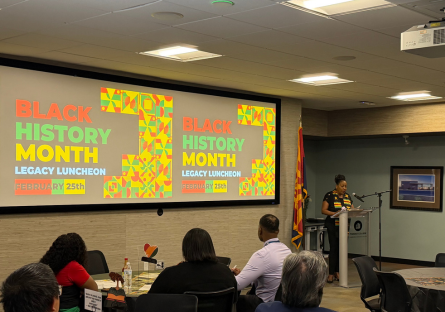
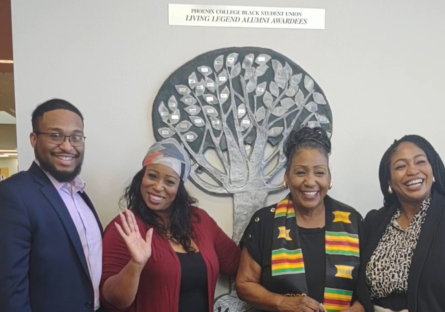
On Wednesday, February 25, Black Student Union (BSU) leadership presented Psychology professor Dr. Debbie Webster with a Living Legend Award during Phoenix College's Black History Month Legacy Luncheon, which honors leaders and advocates who make a lasting, positive impact on the Black community within their colleges and broader society. For her excellence in leadership, service, and community building, Dr. Webster's name was added to the distinguished award recipients on the Living Legacy Award Tree located in Fannin Library. Dr. Webster noted the honor was humbling and profound because of what the tree represents: "A tree grows because our roots, our heritage, our struggles, our trials are deep, resilient, retractable, and unshakable. We all come from different backgrounds and upbringings, but we all share a sense of cultural symmetry."
Born in Philadelphia, Pennsylvania, in a multicultural neighborhood filled with culture, conversation, and community, Dr. Webster was raised by loving parents. Her mother was a devoted homemaker whose strength was quiet yet powerful. Her father was a Philadelphia police officer, which meant many special assignments that demanded discipline, duty, and dignity. One of nine siblings, with four sisters and four brothers, including her twin brother, she attended Catholic school and excelled academically. "The discipline was rigorous, the expectations were high," she said, "but I rose to meet them." After high school, she attended college but also began dancing for touring singers, then joined the US Army Reserves, following in the footsteps of her siblings who served. There she learned "determination outpaces doubts and discipline defeats limitations."
Dr. Webster married, had three daughters, and returned to college to earn a bachelor's degree in business management. She intended to become a corporate lawyer, "but somewhere between theory and practice," she said, her spirit shifted. She realized that "law shaped systems and psychology shaped souls," so she became a psychologist and began her career as a vocational counselor working with individuals who were physically and mentally disabled, helping them return to work, to dignity, and to independence. "I saw firsthand that ability is often masked by circumstances, and that empowerment begins with belief."
She continued her education with a master's degree in Educational Counseling and then a doctorate in Clinical Psychology. For the past 20 years, she has taught in the Maricopa County Community College District, first at Phoenix College and Glendale Community College, and eventually became a residential faculty member at Phoenix College, where she teaches statistics and research. "Data tells stories. Research gives you a voice. Knowledge is power," she said, "but applied knowledge is transformation." Her two grandchildren – a 23-year-old grandson and an eight-year-old granddaughter – remind Dr. Webster that legacy is not about what you say, it is about what you build.
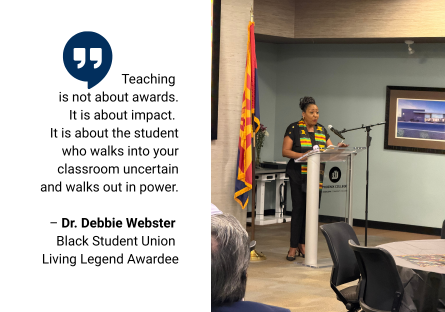
Many of her students have gone on to graduate programs. Some have become counselors, researchers, educators, and leaders in their community. She considers their success her reward. Three years ago, she received the Distinguished Teaching Award, but she is quick to note, "Teaching is not about awards. It is about impact. It is about the student who walks into your classroom uncertain and walks out in power."
Dr. Webster acknowledged students and colleagues present at the luncheon: “To the Black students and to all students in this room: You belong here, not by accident, not by exception. You belong here by right, by intellect, by inheritance." To the faculty and staff, she said, "Your presence is power. Your mentorship is medicine. Your scholarship is resistant. Continue to open doors that were once closed, continue to speak truths that were not built for your voice. Strength is not loud. Strength is consistent. Resilience is not reactive; it is relentless. Pride is not arrogant, it is awareness – an awareness of where we come from and where we are capable of going."