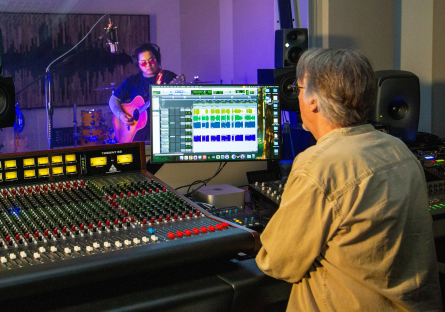
From the outside, you'd never know it was there. Tucked under the Eric Fischl Gallery on Phoenix College's main campus sits one of the most well-equipped audio production programs in the Valley. No flashy signs, no obvious entrance. Just a nondescript door that opens to a world of vintage microphones, isolation booths, mixing consoles, and walls lined with gold and platinum records.
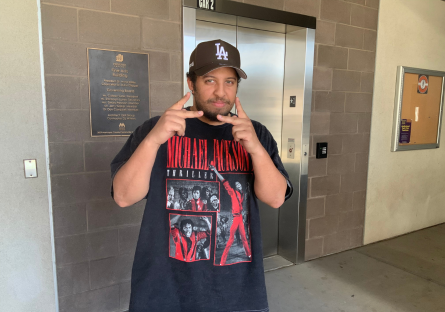
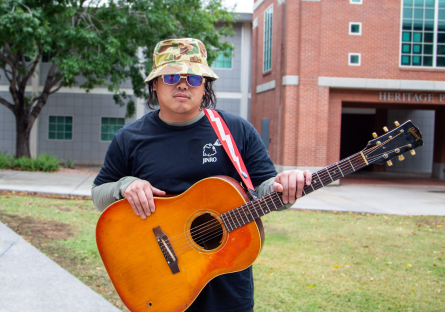
Devon Ellison, a sophomore in the program's Associate in Applied Science (AAS) track, came to Phoenix College almost by accident. He was on campus accompanying his girlfriend to nursing orientation when Dr. Heather Kruse, VP of Student Affairs, struck up a conversation. Devon mentioned he was a producer. Dr. Kruse told him Phoenix College had a recording studio. "I said, 'Bullshit, no way.' I was expecting some rinky-dink, low-ball setup." What he found instead: 35 to 40 professional-grade microphones, multiple studio rooms, and an instructor with serious industry credentials. Devon enrolled on the spot.
The lineage Devon brings to the program is remarkable. His grandfather was a member of the Motown group The Platters, and before that, released a single that caught the ear of Ike Turner, which eventually led to his connection with the Platters' legendary manager, Buck Ram. Devon's father is a multi-instrumentalist drummer; his uncle spent 25 years as the lead singer of a U.S. Air Force traveling ensemble. Music isn't something Devon studied — it's something that runs through him. But even with that heritage, and having already built an independent production career at home, Devon found that the program was filling gaps he didn't know he had.
"Learning different pieces of hardware, what everything sounds like, what everything really does — it's a really in-depth view of everything," he says. "I can damn near identify every microphone I've ever looked at now." The knowledge, he says, is only part of why he's here. The other part is connection — to instructors, to fellow students, and to an industry ecosystem he hadn't been able to access on his own. "I had kind of plateaued," he admits. "I felt like I was doing everything I could on my own, but I wasn't really progressing."
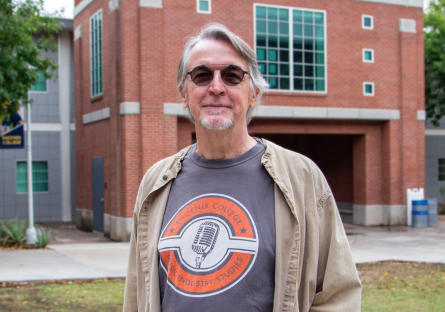
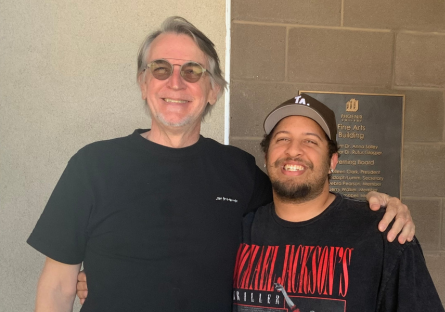
That's where fellow student Joe Drzewieck comes in, although Devon calls him "Sensei," with devotion. "He has been an exciting, unexpected teacher in my life," Devon says. Joe is a retired software engineer and manager with 47 years of experience, a degree in Electrical Engineering and Computer Science from the University of Illinois, and a home recording studio he's operated for 30 years. He is not, by any conventional measure, the typical community college student. But there he was in Studio 3, knowing more than almost anyone in the room — and still learning.
Joe's path to Phoenix College wove through Chicago, Fort Wayne, and two separate stints in Phoenix in a career that saw him manage engineering teams, mentor younger coders, and eventually move into training and education. He notes that some of the best software engineers are also musicians. Joe plays saxophone, built a home studio, worked with acousticians to custom-fit a 30-by-24-foot great room for recording, and spent decades recording singer-songwriters and jazz musicians. And yet he walked into Phoenix College's Music Industry Studies program and found himself learning.
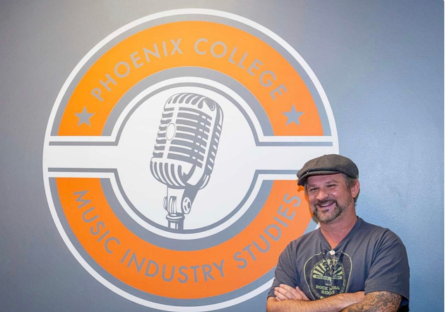
Joe recalled when program director Jamison Weddle — the instructor whose gold and platinum records line the studio wall — demonstrated EQ techniques on a kick drum using a humble SM-57 microphone, walking students through every decision as he made it. "It sounded great," Joe says. "You get these shortcuts from professionals who've been doing it for years. Not workarounds — the right way."
Adjunct instructor Mike Bollenbach, who owns a professional recording studio near the Coliseum, and Patrick Driscoll, who teaches live sound, support Jamison in the studio. The faculty are working professionals, not theorists, and that distinction matters enormously to both Joe and Devon.
Joe compares the program to a well-known private audio school. "You pay $20,000 a year for an education that's nowhere near as good as this," he says. "The one-on-one time you get with Jamie, Mike, and Patrick — you won't get that at these online places." The cost difference is even more striking in Joe's case: as a retiree over 65, he pays half price for every class. "I pay for a semester here what I would pay for one hour of studio time in a third-rate studio," he says.
The curriculum moves from foundational courses in music theory and electronic music through a progressive sequence of studio recording classes, culminating in Studio 3 — a five-hour Friday session that Joe compares, admiringly, to Anthony Bourdain's Kitchen Confidential. "Full-on adrenaline for hours at a time," he says, "and then sitting quietly while the talent records, and then full-on adrenaline again." Real studio time, he notes, runs hundreds of dollars an hour in places like New York, LA, or Nashville. In Studio 3, students learn to work at that pace and in that environment without wasting a moment.
The program also offers courses in sound design, audio mixing techniques, music business, copyright, marketing, and monetization, and culminates in an internship. For Devon, still building his independent career, the credential is secondary. For Joe, who is pursuing a Certificate of Completion – "just because, why not?" – the experience has already paid for itself many times over.
Both men point to something beyond the curriculum that makes the program work: the people you meet inside it. Students bring real projects. Last semester, Joe used his connections to bring five Phoenix jazz musicians into the studio. The group recorded three songs, using nearly every room and facility available — isolating the trombone from the saxophone, managing drum bleed, and working the board in real time. A musician Devon helped record in Studio 3 a year ago recently reached back out to finish an EP [Extended Play], and once he heard Joe play, he had him perform on three of the five tracks.
"It doesn't matter what sort of passion you have in music," Joe says. "Recording is part of it. Whether you're a musician who wants to preserve a performance, a producer who makes beats on a laptop, or someone who wants to do a podcast, you learn what sonic signature means, what mixing means, and how to put it all together."
Phoenix College's Music Industry Studies: Audio Production Technologies program offers both a Certificate of Completion (40 credits) and an Associate in Applied Science degree.
Take a 3-D tour of the Audio Production Studio. To submit your band for consideration for a free recording in the studio or more info about the program, contact Jamison Weddle, [email protected].