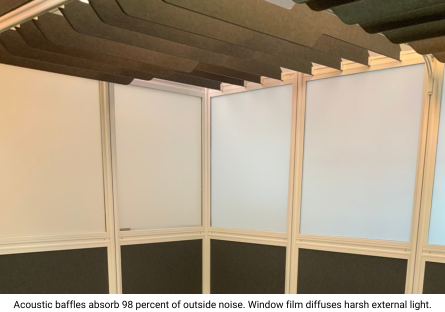
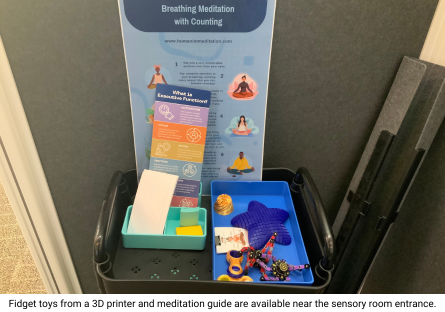
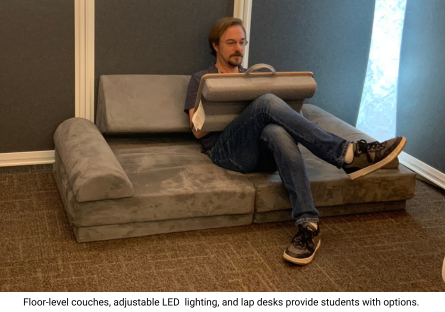
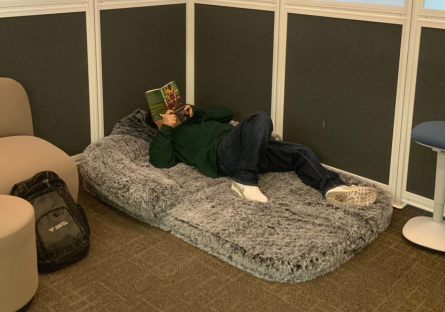
Walk into Phoenix College Learning Commons on the lower level of Fannin Library, and you'll see something in the back of the room most college campuses don't have: two quiet, softly lit rooms designed for students whose brains experience the world differently. There are rocker boards and weighted blankets, floor-level couches and adjustable lighting, and acoustic baffles overhead that absorb 98 percent of outside noise. Window film diffuses harsh external light. A 3D printer nearby produces fidgets throughout the week. The rooms are cozy, unconventional, and entirely intentional — and they exist in large part because of one person's long arc of curiosity, advocacy, and personal discovery.
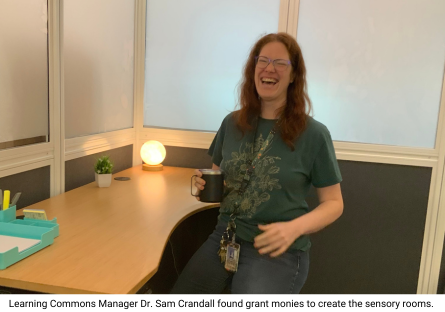
Dr. Sam Crandall, Manager of Phoenix College's Learning Commons, has spent years building toward this moment.
From Workshops to the Classroom
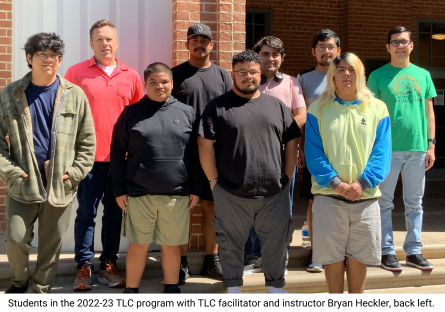
Three years ago, Crandall began working with Phoenix Union High School's Transitioning Learners to College (TLC) program — a partnership that places high school graduates with Individualized Education Programs (IEPs) on Phoenix College's campus to experience college coursework. In that first year, she developed and delivered a series of 12 study skills workshops for the students. It was harder than expected. The students were enrolled in different courses with different instructors, different assignments, and different expectations, making it difficult to contextualize the study strategies she was teaching.
When the program's curriculum shifted from a counseling-only CPD course to a First Year Experience format, Crandall was eligible to step in as a First Year Experience (FYE103) instructor. She took the course and ran with it — and then, recognizing that keeping TLC students siloed from the broader college population was limiting their integration, she connected with adjunct faculty member Kim Duru. The two instructors shared the same FYE curriculum and the same assignments, dividing students between their sections so that the TLC cohort could study alongside their peers while still receiving consistent, coordinated support.
Working with TLC deepened Crandall's awareness of something that isn’t always addressed in the field: standard classroom accommodations don't begin to cover what neurodivergent students actually need to navigate college life. Accommodations require documentation. They require students to register with a Disability Resource Center — itself a barrier for many. And they apply only inside the classroom, leaving untouched the executive function challenges that shape every other hour of a student's day.
Around this time, something personal shifted Crandall's perspective even further. Her son's therapist suggested he might be neurodivergent. "If he's neurodivergent, I am too," Crandall recalls thinking, "because he is a mini-me." She and her son went through the diagnosis process together, which she described as grueling and emotionally complex, but it deepened both her empathy and her professional focus. "It kind of explains why I had that connection to this population of students," she said. "I continued to feel this passion where I wanted to do more."
Six Months at Gateway
That desire to do more took concrete shape in 2024, when Crandall submitted a proposal to MCCCD's Creative Pathways program and was selected for a six-month full-time internship at Gateway Community College. Her proposal outlined an ambitious, four-part framework for supporting neurodiverse students: a dedicated FYE103 course section, co-curricular programming targeting executive function skills, a sensory-friendly community space staffed with learning support personnel, and professional development on neurodiversity for faculty and staff across the college.
At Gateway, Crandall threw herself into research. She conducted virtual site visits of sensory spaces at other colleges, including Michigan State University's Spartan Family Sensory Room and Mesa Community College's reservable sensory study room. She consulted with neurodivergent professionals in higher education, met with staff and faculty developers, and delivered a series of workshops she called "Outside the Box" — covering neurodiversity in general, autism specifically, and even neurodiversity as it appears (and is often miscoded) in pop culture. She also worked with neurodivergent students and a tutor through GateWay's Learning Center to develop and map academic support strategies based on the six domains of executive function: activation, action, energy, focus, memory, and emotion.
Back at Phoenix College
When her Creative Pathways internship concluded, Crandall returned to Phoenix College carrying a blueprint, a body of research, and momentum. Tapping into the National Telecommunications and Information Administration (NTIA) Connecting Minority Communities (CMC) grant administered by Associate Vice President Paul Ross, she secured funding for the sensory rooms themselves — standing desks with adjustable heights from Uplift, a range of seating options from floor-level cushions to standard office chairs. Everything else came from her team's office supply budget: floor cushions, a yoga mat, and LED lights with warm-toned adjustable settings.
The design choices were deliberate. Crandall delayed promoting the rooms until acoustic baffles were installed on the ceiling because the nearby HVAC vent, amplified by the soundproofed walls, created exactly the kind of sensory irritant the space was meant to eliminate. She chose warm-toned lighting covers because of the documented difference between blue-spectrum and warm light. She left some seating facing outward with a clear panel in the room making the larger room visible — specifically, she explained, so that students with PTSD wouldn't feel trapped with their backs to an enclosed space.
“It’s about having a lot of flexibility, a lot of different options,” Crandall said.
The rooms are also the home base for a new Neurodiversity Success Program Crandall launched this semester, piloting the kind of cohort-based, opt-in support structure she had long envisioned. The acronym SUCCESS stands for: Support, Understanding, Connection, Communication differences, Empowerment, Skills and Strategies. The program is open to any student, with no diagnosis required. Students sign up through a Google form, and the cohort gathers for body doubling sessions, Wednesday workshops on topics they chose themselves, and informal community. Body doubling, Crandall explains, is the simple but powerful practice of doing hard things alongside someone else. "If I want to get in shape, I can buy things that sit at home unused," she said. "But I'm more likely to exercise when I go to the gym with a friend."
Some students join virtually via Google Meet and work in silence from their homes. Afterward, Crandall receives messages: I just really needed this. I needed this specific time that I was doing something today.
An Invitation
The sensory rooms are available to any student. Crandall's hope for the space — and for the broader work — is straightforward: come experience the rooms. If you're faculty or staff wondering why a student seems distracted, disorganized, or slow to start a task, consider that there may be an explanation that has nothing to do with motivation.
"I want to encourage people to be open to alternate explanations and stories," she said — especially when what looks like procrastination might be something else entirely: a brain working harder than anyone can see, in a world not quite built for it yet.
The campus community is welcome to stop by or reach out to the Learning Commons for more information. Crandall is open to sharing her knowledge through conversation and professional development sessions. Contact her at [email protected] or 602-285-7476.