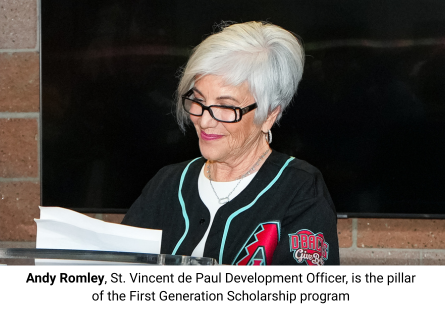
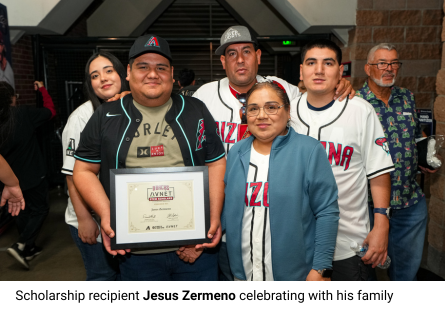
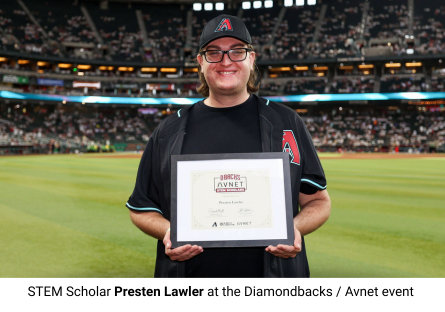
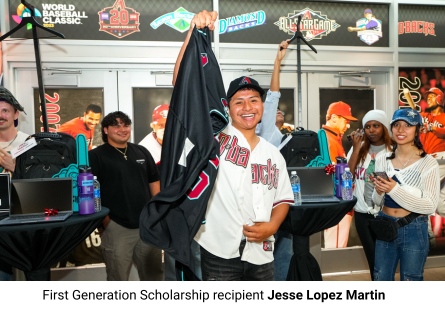
It started with a conversation in an industrial kitchen. A Phoenix College (PC) student working at St. Vincent de Paul told Development Officer Andy Romley, who coordinates St. Vincent de Paul First Generation Scholarships, about a PC counselor who had been helping him. The student spoke so highly of the counselor, Dr. Violetta Lopez-Armijo, and the support she provided him navigating scholarships and career planning, that Romley asked if she could meet her. The student put Romley and Lopez-Armijo in touch and that simple introduction in 2019 sparked a partnership that now supports dozens of first-generation students pursuing some of the most challenging degrees in higher education.
Lopez-Armijo knew about St. Vincent de Paul’s services: “It's always been one of our main resources when we're connecting students to basic needs–food, emergency rent, volunteer opportunities,” so when Romley invited Lopez Armijo to join the leadership of the scholarship program the timing felt like destiny. "If I ever won the lottery, my calling would be to have a scholarship to support first-generation students like myself," says Lopez-Armijo, who grew up in Rio Rico, a small rural town neighboring Nogales and the Mexican border.
What began as 15 scholarships for PC students between 2002 to 2018, has evolved into a comprehensive six-year partnership between Phoenix College's Counseling Department and St. Vincent de Paul’s First Gen Scholarships, when Lopez Armijo was invited to join the scholarship leadership team in 2019. Since then, an additional 36 Phoenix College students have been accepted to the program for a total of 51 PC students.
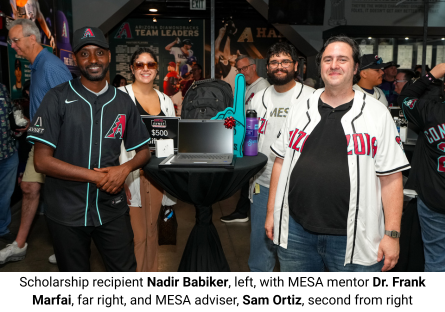
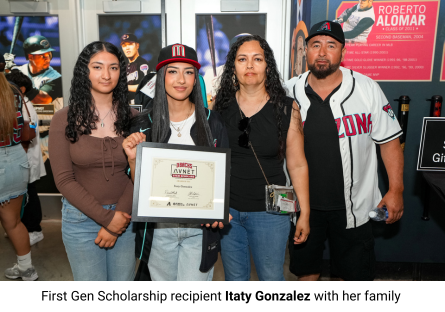
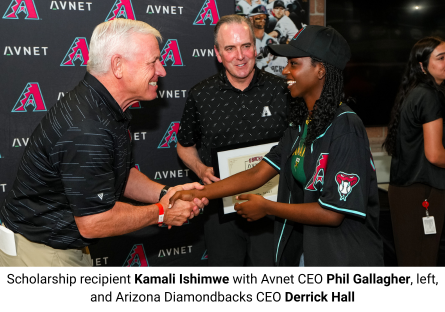
PC’s Math, Engineering, Science Achievement (MESA) program joined the partnership last year, nominating four students–Nadir Babiker, Kamali Ishimwe, Jesse Lopez Martin, and Jesus Zermeno–to apply for the Fall 2025 scholar cohort, all of whom were awarded a scholarship. Additional students in the Fall 2025 cohort include STEM students Itaty Gonzalez, Presten Lawler, Earlean Howard and Natalia Garcia, who have transferred from PC to ASU.
Together, these distinct partners of the program created an ecosystem where first-gen students receive not just financial aid, but academic support, personal counseling, and life-changing mentorship.
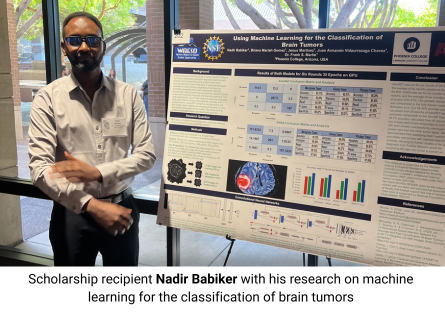
For first-gen students like Nadir Babiker, who came to the United States from Sudan with only $20 in his pocket, this circle of support has been transformative. "It changed my life," he says about the St. Vincent de Paul scholarship. "I used to do four jobs—Amazon delivery, Uber, Lyft, and school driving in the early morning. Now I'm doing just two jobs and I'm a full-time student." Babiker kept the job driving students to school and also works in PC’s Learning Commons as a Math and Computer Science tutor. He’s also a member of the PC’s MESA program, a nationally recognized initiative designed to meet workforce demands in Science, Technology, Engineering and Mathematics (STEM).
Building STEM Excellence
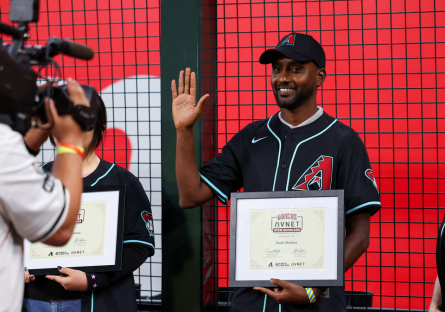
For the past three years, the St. Vincent de Paul First Generation Scholarship has partnered with AVNET/Diamondbacks emphasizing support for STEM students in their educational journey. At PC, the MESA Program serves as a community hub where students access computers, STEM textbooks, and academic supplies while connecting with tutors, guest speakers, and industry recruiters. Students master complex technical concepts through collaborative, peer-facilitated learning, while a STEM Success Orientation Course prepares first-year students for academic excellence and career preparation.
The MESA approach works. Scholars earn higher GPAs than other calculus-based STEM students—3.1 compared to 2.76—and are more likely to persist, transfer to a university, and earn STEM-related bachelor's degrees.
For Babiker, MESA opened doors he didn't know existed. Since joining the program in Fall 2024, he has participated in machine learning for the classification of brain tumors in a collaboration with the Western Alliance to Expand Student Opportunities (WAESO) at ASU, attended conferences at both ASU Tempe and ASU West as well as the Arizona-Nevada Academy of Science (ANAS), and gained hands-on experience in AI applications. "I really appreciate the things MESA is doing for me and other students,” Babiker says. “It makes another home for the students and connects us to each other."
Phoenix College math professor and MESA mentor Dr. Frank Marfai explains the power of the program's mentorship model. "Students have figured out that every mentor has expertise in different areas," he says. "If you talk to Frank, you'll learn about this. If you talk to Marcia Corby, you’ll learn about this. Ours students oftentimes have what I call a network of mentors." That network proves critical when students apply for scholarships, internships, or university programs. "Our students are not always their best self advocates," Frank notes. "That's where the mentor can help them shine—pointing out accomplishments they forgot to mention or volunteer work they never listed."
Dedicated MESA staff provides academic advising, transfer assistance, and workshops that encourage exploration of careers and academic majors—including tours of local industry and university partners that introduce students to corporate culture and the interview process. This comprehensive preparation creates the academic foundation and professional readiness that makes students competitive scholarship candidates—and future STEM professionals.
The Heart of Student Support
St. Vincent de Paul’s Romley admires PC's Counseling Department: "They follow up with kids, whether the kids want them to follow up or not," she says. Indeed, they don't wait for students to seek help—they reach out, check in, and stay connected because they know first-generation students often don't know what to ask for or when to ask for it.
Lopez-Armijo is a "master of giving options." She helps students develop their own problem-solving skills rather than simply directing them. She and other PC counselors provide comprehensive support: academic planning, personal counseling, crisis intervention, help navigating college systems, and connecting students to resources. Their cultural competency—understanding family structures, contexts (many families are monolingual Spanish), and the unique challenges first-gen students face—makes them particularly effective.
"The imposter syndrome is real,” says Lopez-Armijo. “It's a lifelong journey that can be harnessed into motivation," she says, reflecting on her own experience as a first-generation graduate. "It is so scary not knowing where to go, who to lean on, what to ask."
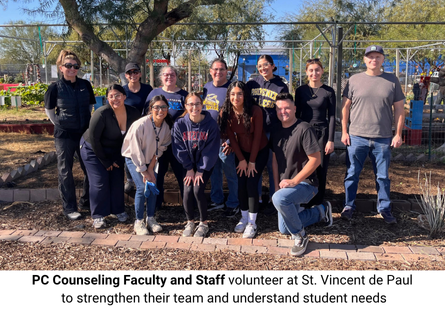
Despite decreasing funding and fewer counseling faculty, their commitment has only deepened. Four faculty now serve as St. Vincent de Paul mentors–Fred Amador (three years), Joanna Torres (two years), Dr. Alice Chi (two years), Dr. Kristen Sergeant (one year)–as well as Vice President of Academic Affairs Adrianna Coronel (two years). In weekly meetings, the counselors identify students with a "fire in their belly"—resilient, determined, academically committed. Led by Dr. Roberto Villegas-Gold, the entire department volunteers at St. Vincent de Paul together, strengthening both their team and their understanding of student needs. Scholarship recipient Itaty Gonzalez works part-time in PC's Counseling department as she continues her Dentistry program at ASU.
For Babiker, Phoenix College has become family. "I'm an immigrant. I left my home, my family. I have no one here except me," he explains. "Working here, the math department, Biology, and all my teachers—I have a great relationship with all my teachers––makes me feel like I’m home."
The counseling support helps PC students handle the "transitional, non-academic challenges" that could derail their education—providing the navigation and personal guidance that makes academic achievement possible. "Their success is not just my success,” says Lopez-Armijo, “It’s a win for all of us. This is why we are here, for students. We are beyond grateful for St. Vincent de Paul and all the support provided to our PC students. This partnership has been life changing for so many students.”
Completing the Circle
In 2001, Terry Wilson founded St. Vincent de Paul's First Generation Scholarship with a simple belief: students need to graduate from college or trade schools. Wilson himself was a first-gen student whose college education was only possible because someone invested in him. Nearly 25 years later, his vision has grown from ten students to a robust program with intentional structure and remarkable results.
When Romley—"the pillar" according to Lopez-Armijo—took over the scholarship program, she fortified its foundations with a dedicated team that includes Lopez-Armijo, first-gen Vincentian volunteer and networking powerhouse Stacy Cotroneo, Metro Tech High School retired couselor Dora Villa, ASU TRIO director Erica Hodges, and ASU Barrett Honors College Academic Student Success Advisor Teresa Guerra. Together, they've created a financial structure that fills gaps: up to $7,000 annually, scaled to need. Students might receive $500 per semester at community college, increasing to $3,500 per semester at university as other aid runs out.
For Babiker, the financial assistance has been life-changing. "The assistance check has helped me a lot," he says. "It's giving me time to rest—not just to rest, but to study more. Before, I couldn't afford to be a full-time student because I worked many different jobs."
But money isn't what makes this program special—it's the one-to-one mentorship that lasts the duration of the scholarship and beyond. "Serving and giving are at the very core" of the Vincentian mission, says Romley, emphasizing accountability with compassion.
Babiker meets with his mentor Charlie, a former university president, regularly. "We schedule one hour, but we go beyond by half an hour," Babiker says. Their conversations range from mathematics to philosophy to teaching. "We always touch on teaching and real life—how as a teacher or tutor or student, you can transfer your knowledge and share your experience. He's always encouraging me to do more and appreciate what I have."
Romley observes the transformation with wonder. "I'm more transformed than they are," she says about working with scholars like Babiker, who walked into Phoenix College barely speaking English. Now, he is pursuing software engineering at ASU while running his own technology company called Core Mind, tutoring PC students, and maintaining a 3.82 GPA.
"When I got the scholarship, one of my friends said, 'This is luck,'" Babiker recalls. "I told him, 'No, this is not luck. I got it, because I have been working and studying so hard.’"
A Model for Student Success
The partnership between PC Counseling, St. Vincent de Paul and MESA proves that supporting first-generation students requires more than any single organization can provide. Academic preparation, personal guidance, financial relief, wrap-around services that support basic needs, and professional mentorship must work together—each partner strengthening the others.
The impact is clear. The first-gen scholarships students are graduating and paying it forward. Babiker started his PC journey struggling with a computer survey class but now helps other students believe in themselves. "I told a student who was about to give up, 'You can do anything,’” he says. “That conversation changed her. Last week I saw her wearing a uniform for dental hygiene. She's thinking about opening her own practice."
That's the power of a circle of support—it doesn't just lift individual students. It creates a cycle of success where those who receive help become the helpers, where mentorship becomes legacy, and where first-generation STEM students don't just survive—they thrive and inspire others to do the same.
To become a St. Vincent de Paul First Generation Scholarship mentor or support the program, contact Andy Romley at St. Vincent de Paul, [email protected].
To become a Phoenix College's MESA program mentor or corporate sponsor, email: [email protected].