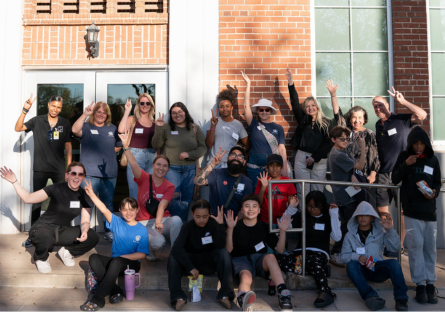
In his late 20s, Cooper Lyon was stuck in a menial job and wanted to do something more fulfilling with his life. "Getting older, I started thinking about saving money, having kids, and starting a family," he said. "Both my partner and I decided it would be good if we quit our jobs and went to school." They enrolled at Phoenix College (PC) and started their first semester in Spring 2025. Lyon is pursuing a counseling degree, and his partner is in the nursing program.
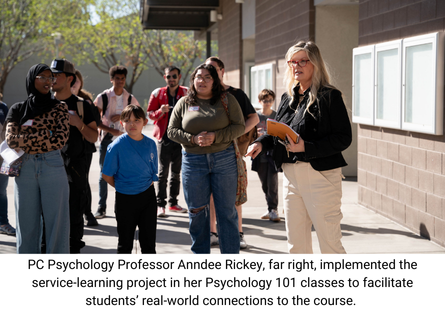
Eager to get his prereqs out of the way, Lyon registered for a Psychology 101 class with Professor Anndee Rickey. Rickey became a full-time PC residential faculty member three years ago after 19 years as an adjunct professor and former Program & Evaluation Director for local nonprofit Kids in Focus (KIF), dedicated to mentoring youth to overcome adversity and build resilience through the art of photography.
A former colleague from KIF reached out late last year to ask Rickey if she knew anyone who might provide additional support for KIF students in a G-Road mentoring program at Emerson Elementary and Children's First Leadership Academy (CFLA). G-Road founder Daniel Stanton is a Phoenix College alumnus, so the connection felt serendipitous. Rickey added a service-learning component to her Psychology 101 class, with her PC students becoming pen pals to the elementary school students.
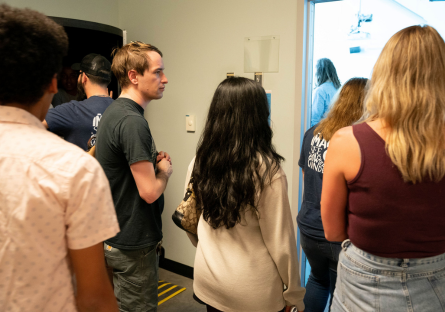
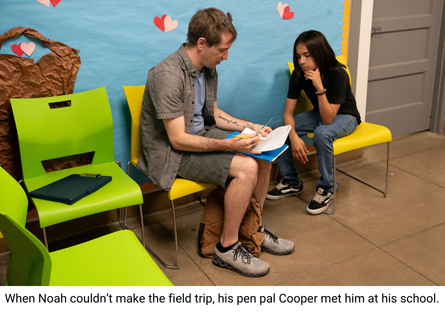
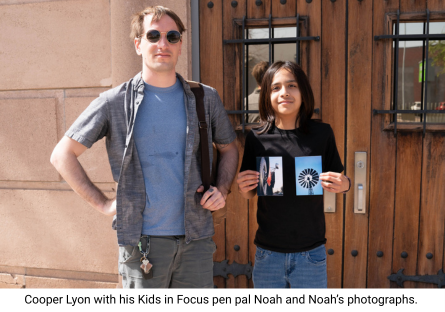
The PC students exchanged journals with their pen pal each week for six weeks. The young students shared their photos and feelings, and the PC students wrote back. Then, the elementary students came to PC for a tour of the photography department and met their pen pals in person. The PC psychology students helped the KIF students write an artist bio, create titles for their photos, and select which images to include in the KIF exhibition. Unfortunately, Lyon's pen pal, Noah, couldn't make the field trip, so Lyon made the time to visit Noah at his school.
"This kind of personal attention and positive response is healing to their pen pals," Rickey said, "but also inspiring to the college students, showing themselves how much they have to offer to others' psychological well-being."
Rickey noted that one of the most critical aspects of education is for students to see the relevance of the knowledge they gain in the classroom to their lives. In the Psych 101 class, Rickey put her students into four groups to analyze the psychological benefits for themselves and the kids in the program through the lens of a concept they had studied in the class. "They apply that concept to the psychological benefits they identified in the Kids in Focus photography mentoring program and share that connection with their classmates," Rickey said.
"By the end of the project, 16 to 20 different class concepts are analyzed that demonstrate a rich connection between the psychology class material and the real world we live in."
Years ago, Lyon had taken college classes in Tucson, which were purely academic, he said. The service-learning was a new experience, and Lyon wondered how Professor Rickey was going to tie the service-learning experience back to concrete psychology. "She found a very cool way to do that," he said, "giving us a fair amount of personal liberties, as well as directing us in applying our knowledge."
Lyon found service learning a "very effective way of teaching in a concrete manner," he said. "A lot of people get bogged down in textbooks and traditional academia. If an instructor can tie in something that not only gives you a way to reflect on what you're learning, but gives back to somebody else, that's fantastic. I was not concerned about how well I had digested the information. The project and the paper took my knowledge from something theoretical to something that I can use daily."
One of the theories Lyon explored was the Theory of Empathy Altruism. "The theory itself is that we've evolved to have natural caretaking behaviors when we see a person in need," Lyon explained. "And I've definitely felt that consistently throughout my life. Obviously, going into the field [of counseling], I believe that's one of the best ways we can support each other."
Professor Rickey hopes to continue the service-learning opportunities in her Psych 101 class, with a reminder that learning happens anywhere we provide the resources and the circumstances for students to demonstrate their knowledge. And the chance to integrate that learning into service and impact the lives of young students? Even better.
Phoenix College has service-learning resources for students, faculty and community partners. Reach out to Alicia Middleton in Career Services, [email protected] or 602-285-7422 for more information.
Make a difference in your community and impact others in the service professions. Consider a career in Counseling, Nursing, or Public Safety Administration.