Edgar Fernandez was at a South Mountain gathering with his family when he saw his abuelo — a man in his nineties who still farms corn in his hometown in Mexico — standing quietly at the edge of the mountain, wearing his tejana hat and a printed shirt with surfboards. Fernandez pulled out his camera.
"He didn't know I took a photo," the Phoenix muralist and painter says. "But his face says so much."
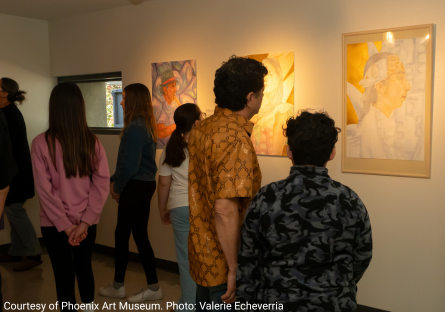
That image became a graphite and gouache portrait in Cultural Identity, Fernandez’s exhibition on view through May 31 in the Phoenix Art Museum's Administration Building. In the drawing, Fernandez replaced the surfboards on his abuelo’s shirt with ears of corn, referencing the land and lineage of corn fields that have been tended across generations in his family. For Fernandez this is his artistic territory: the intersection of personal history, indigenous heritage, and the living culture of communities that too often go unrepresented in gallery spaces.
Path to Art
Fernandez was born in Los Angeles, but his family moved to Michigan, then to the Central Valley in Orosi, California — farm country, where his mother's sister still lives today — before his father decided to try Phoenix in the year 2000. "We had no family here, nothing," Fernandez recalls. "But it was a growing city with job opportunities, and houses were more affordable." They've been here ever since.
His path into art was equally circuitous, and not without setbacks. He started doing graffiti in middle school, drawn to letterforms and the freedom of it. When he got to high school, his first art teacher kicked him out of class for drawing graffiti on paper — not on desks, not on walls, just on paper. It was discouraging enough that he doubted whether art was even a path open to him.
Years later, Fernandez was commissioned to paint a mural at the very school where that teacher had relocated, but this time he was getting paid by the city to paint a mural in collaboration with the elementary students. "Full circle," he says, and laughs.
Phoenix College opened the door to the art world for him. He spent seven years on campus— deliberately, not drifting — cycling through ceramics, photography, sculpture, drawing, and painting, refining his artistic practice. He took a painting class with Steven Yazzie, a celebrated Navajo/Laguna Pueblo artist who only taught a few years before moving to Denver. "I was lucky that I caught him," Fernandez says. Yazzie took his students to visit working artists' studios, showing them what a sustainable creative life could look like. "I was like, Whoa, this is how they make a living. I could do it too."
Fernandez won a Vanguard Award in 2015, an award created in 2005 by PC alumnus and contemporary figurative painter Eric Fischl to recognize emerging student talent in the fine arts. Fischl’s solo exhibition, Stories Told, is on view in the Phoenix Art Museum Steele Gallery through June 14.
For several years, Fernandez worked as a studio assistant to Phoenix-based artist John Randall Nelson — twelve to fifteen hours a week, attending meetings, assisting in the fabrication of sculptures, and watching the whole ecosystem of an artist's career up close. He went on to earn his degree in fine arts from ASU and founded Sun Snail Studio, to connect viewers to a deeper part of themselves through the experience of artwork rooted in cultural identity.
Significance of Corn
Corn is everywhere in Fernandez's work, and it means more than it might first appear. He traces it to the Popol Vuh, the Mayan creation text that survived the Spanish attempt to colonize the indigenous people of Mesoamerica and where the majority of the texts were destroyed. In that story, humanity passes through several stages before arriving at its final form: people of corn. The metaphor resonates deeply with Fernandez, partly because of how corn actually grows. Unlike most plants, it cannot self-pollinate in small numbers — it needs human care, proximity, community. "It’s almost like taking care of a baby," he says. "Corn needs a lot of attention."
There is also the family dimension. His grandfather, well into his nineties, still tends corn in Mexico. His mother, as one of the older children, worked alongside her father in the fields. Corn connects the cosmological to the domestic, the ancient to the everyday — which is precisely what Fernandez's art tries to do.
Residency at Maryvale High School
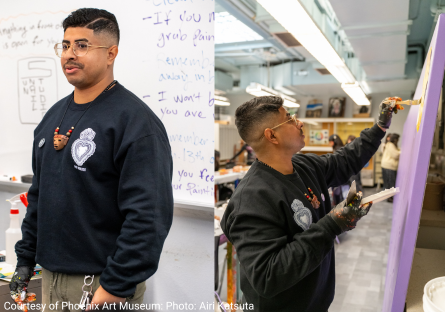
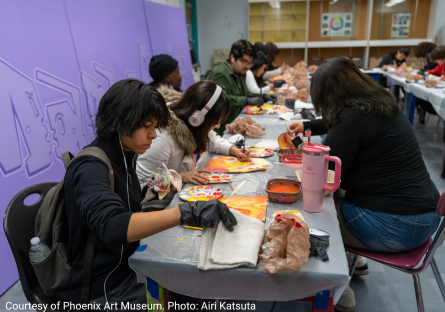
Cultural Identity grew out of a residency program run by the Phoenix Art Museum and the Men’s Art Council, now in its third year, which pairs a local artist with a local high school to create collaborative work. Fernandez was connected with Maryvale High School — in a neighborhood where he has deep roots and painted a mural a decade ago with Poder in Action, a local organization dedicated to social justice in this community. He went in expecting to be there for four or five days. He ended up staying a month alongside the Maryvale High School students.
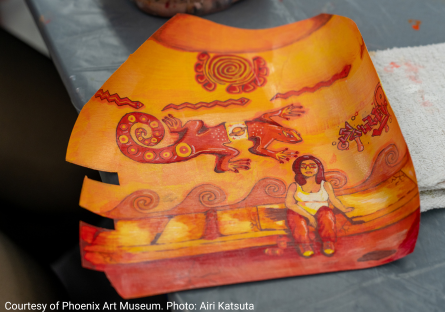
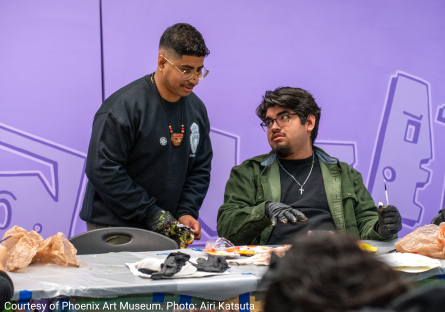
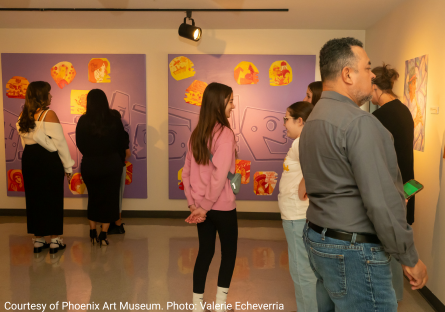
Working with a pre-selected group of students — about 23 in all — Fernandez introduced them to polytab, a mural-cloth technique developed in Philadelphia in the 1990s so muralists could work indoors during cold months and install their work later. (In Phoenix, the logic flips: you work in a climate-controlled studio and avoid the brutal heat of painting on-site.) He walked the students through his own practice, doing demos, teaching wash techniques, setting a limited palette of warm yellows, oranges, and reds against a purple background to create cohesion and visual pop.
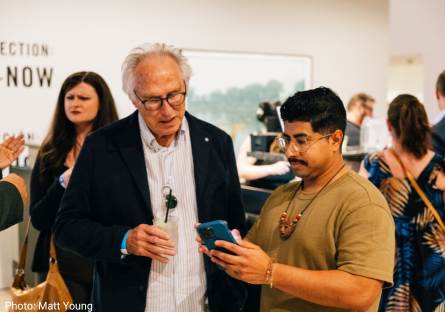
The prompt he gave them was simple: cultural identity. Connect the artwork to yourself, your family, your ancestors. If you're stuck, ask questions —talk to your parents, your grandparents, dig up the stories. The results were vivid and specific: a can of Fanta, crop imagery tied to family farms, names and symbols drawn from their family’s heritage. "They all have their own individual connection to their cultural relevance," Fernandez says. "To themselves. To their family." Students who had been shy and quiet during the residency found themselves stepping up to describe their work in front of a crowd at the exhibition opening in February.
Cultural Identity Exhibition
The exhibition weaves together the student mural with Fernandez's own paintings, including a series of oversized watercolor portraits of Zarco Guerrero, a Mesa-based artist, musician, and mask-maker who is one of Fernandez's mentors; Monica Gisel, a local Mexican artist and colleague who is a big inspiration within Fernandez’s work; and Luname, his guide-child (not godson — Fernandez and his fiancée Elida Acosta are not religious, so they use a different word), who went through an Mexica coming-of-age ceremony that the couple witnessed firsthand.
And there are the portraits of those who have passed away: Joey Acosta, his fiancée's youngest brother, killed at 18; two godfathers, one who died of a sudden heart attack while tending his garden, another — a beloved cobbler and community fixture in downtown Mesa — taken by senseless violence in 2023. These are not elegies of grief so much as acts of witness, of insisting that these lives be seen in the careful, loving scale that portraiture demands.
Don't miss Cultural Identity, on view through May 31 at the Phoenix Art Museum's Administration Building, 1st Floor Gallery, 1625 N. Central Ave., Phoenix. Admission is free.